

How Long Does Spray Foam Take to Cure
When the next trade can walk in.
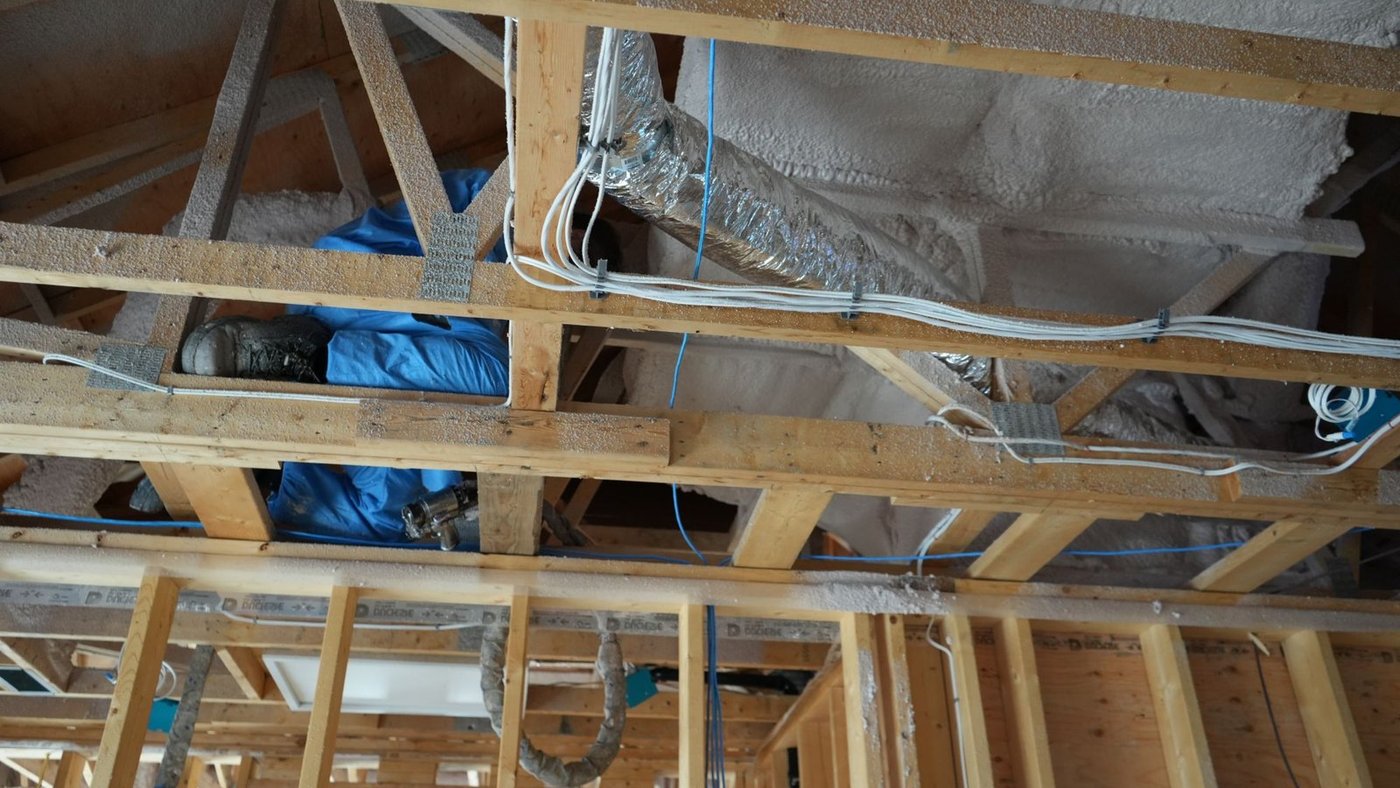
"How long does spray foam take to cure?" sounds like the question a spray day turns on, and the honest answer is that cure is not the number the schedule runs on.
Closed-cell foam expands in seconds and sets within minutes. Neither fact tells you when your drywaller, your electrician or the owner can walk back into the space. Three separate clocks do that, and only one of them belongs to the foam.
Cure, re-entry and cover are three different clocks
- Cure is the chemistry. The two components react as they leave the gun, the foam expands and sets, and it keeps curing for some hours after it looks finished. Barrie Insulation Systems' own FAQ puts it plainly: properly mixed and applied foam cures within hours and is stable after that.
- Re-entry is the safety window. It is set by the manufacturer for that product, with the space ventilated, and it decides when anybody without a supplied-air respirator can be back in the space.
- Cover is the code. Foam in an occupied space has to be separated from the interior by a thermal barrier, so the job is not finished for the inspector until the drywall, or an approved coating, is on.
Build the schedule on the second and third. The first one takes care of itself as long as the foam went on right.
How long does spray foam take to cure between lifts?
This is the clock inside the spray day, and on a given job it's most of the answer to how long does spray foam take to cure: a deep cavity takes longer than its square footage suggests. Closed-cell foam goes on in lifts, not one thick pass. The reaction makes heat, and a lift sprayed too thick, or sprayed onto one that hasn't cooled, can overheat, crack or pull away from the framing.
Manufacturers write this into their application instructions. Elastochem's technical guide for its Insulthane Extreme closed-cell foam, for example, cites CAN/ULC-S705.2 for a pass of 15 mm minimum and 50 mm maximum, and has the installer record the core temperature of each pass and let it fall below 100°F before spraying the next. Barrie Insulation Systems describes its own work the same way: foam applied in controlled lifts at documented thicknesses by certified applicators. A rafter bay that needs several lifts is a longer day than a rim joist that needs one, which is the main reason two jobs of the same area don't take the same time.
The re-entry period: where the number comes from
There is no single figure for every product, and anyone quoting you one without naming the foam is guessing. The re-entry time comes from the manufacturer of the product being sprayed, and it assumes the space is ventilated the way the instructions say.
To show what one of those instructions looks like: the same Elastochem guide says to wait 24 hours after application, with ventilation, before re-occupying the living space, and calls for mechanical ventilation at a minimum of 0.3 air changes per hour during and after the spray. That is one product's sheet. Other foams carry other figures, which is exactly why the number has to come from the product on your job.
Barrie Insulation Systems sprays Polarfoam 7300-0 SOYA, a 2 lb closed-cell foam, and says on its spray foam page that it gives you the re-entry time for your job before it starts. Ask for it when you book the crew, and put it on the schedule as a hard line, not an estimate.
For an occupied house, their FAQ says they schedule around that period so that for most basements and attics the owners are back in the same day. On a new build there's no owner to move out, but the same window applies to your trades.
Who can be on site while the foam goes on
This is where a spray day collides with everybody else's. During application, the crew wears supplied-air respirators and the space is ventilated before any foam is mixed. Any trade without that equipment is out of the area.
How far out depends on the instructions. The Elastochem guide, for instance, requires fresh-air breathing apparatus for the installers and any other trades or helpers within 10 metres of the applicator. On a house with an open stair or no doors hung yet, the work area is bigger than the room being sprayed.
- Don't book another trade inside the house on spray day unless the spray area is properly isolated and their work is somewhere the instructions allow.
- Exterior trades are a separate question. A roofer or a siding crew outside a closed-up house is a different situation from a framer finishing a partition one room over. Ask the applicator before assuming.
- Re-entry applies to your trades too, not just to occupants. Nobody without a respirator goes back in until the period has passed.
What has to be ready before the spray crew arrives
A spray day that has to stop because something wasn't done costs a second mobilisation, a second ventilation set-up and a second re-entry window. Most of that is avoidable.
- Rough-ins complete and inspected. Wiring, plumbing, ductwork, low-voltage and any blocking. Cutting a box into a rim joist after it's foamed is a repair, not an adjustment.
- The building closed in. Roof on, windows and doors in, sheathing complete. Foam bonds to the substrate, and a wet substrate is a poor bond.
- The space within temperature. Foam is applied only when the substrate and the air are within the manufacturer's limits. In a Simcoe County winter that can mean heating the space before the crew arrives. Ask which grade of foam is coming and what it needs.
- Nothing in the way that shouldn't be sprayed. The crew masks everything that shouldn't get foam on it before ventilation is set up. Less to mask means a shorter day.
- The thermal barrier decided. Know before spray day whether each area gets drywall or a coating, and who is supplying it.
- The schedule holding the re-entry window. Leave the period after spraying empty on the calendar. Don't book the drywall delivery into it.
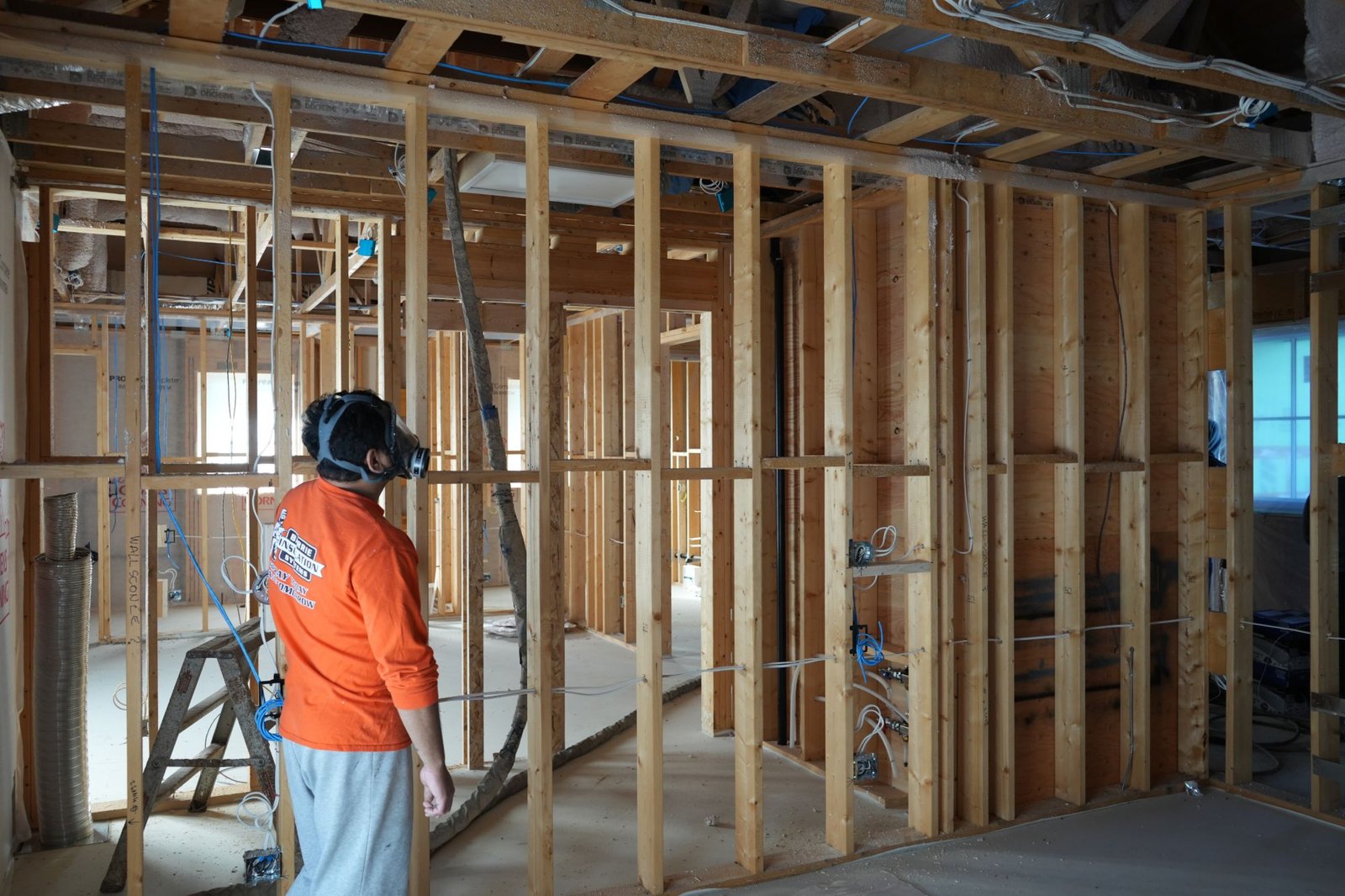
How long does spray foam take to cure before drywall?
Once foam has set it can be trimmed. Barrie Insulation Systems' process is to trim the excess flush, check the coverage, and leave the work ready for the building inspector and the next trade, then remove the masking and debris.
The Ontario Building Code requires foam in occupied spaces to be covered by a thermal barrier, usually drywall, or an approved coating where drywall isn't practical. The thermal barrier post covers which areas need what. For the schedule, the point is simple: an inspector looking at open foam in a living space is looking at an unfinished job, so the drywall date is part of the foam's timeline, not the drywaller's alone.
So the useful answer for the drywaller is this: once the re-entry period has passed and the foam is trimmed and inspected, the board can go up. The curing itself won't be what holds them back.
When the schedule says the cheaper option is the better one
A spray day closes the work area to every other trade and then holds it shut until re-entry. On a tight build that's a real cost, and it's worth weighing against what the foam is doing in each spot.
Closed-cell foam earns that day where it's doing three jobs at once: rim joists, cathedral ceilings, below-grade walls, a floor over a garage. In a standard 2x6 exterior wall with poly and drywall over it, a batt or BIBS fill gets you to the code value without a re-entry window. Barrie Insulation Systems says on its batt insulation page that it routinely foams the rim joists and problem areas and batts the rest, the best performance for the budget, and it says on its spray foam page that it will tell you when a cheaper product will do the same job.
That split also shrinks the spray day. Foam only the rim joists and the awkward spots and the crew is in and out sooner, the re-entry window closes off less of the house, and the batt or blown-in crew can follow without waiting on anybody's respirator. The spray foam vs blown-in vs batt comparison goes through where each one belongs.
Where we fit
We spray Polarfoam 7300-0 SOYA under CAN/ULC-S705.2 with certified applicators, and we install BIBS and batt as well, so the quote can put the right product in each part of the house. We give you the re-entry time for the job before we start, we schedule large new builds around your other trades, and we leave the space trimmed, clean and ready for the inspector and the drywall crew. See spray foam insulation for how a job runs, and closed-cell spray foam for where it's the specified answer.
Building the schedule and need the spray day pinned down? Call (705) 812-1955 or request a free quote.