

Spray Foam and Mice
Foam takes away the bedding. It doesn't lock the door.

Spray foam and mice come up together because of one hope: that a new insulation job will also end the scratching in the ceiling. Foam changes a lot about a mouse problem. It does not end one by itself, and the difference matters before you spend money.
Here is what closed-cell foam actually does, what it doesn't, and the order that keeps you from paying twice.
What foam takes away from a mouse
Loose insulation is a mouse's ideal home. Fibreglass batts and old blown-in material give them runways to travel through, nesting material to shred, and a warm, dark place nobody looks at. A mouse in your attic or your basement header is usually living in the insulation, not just passing over it.
Closed-cell spray foam removes that. It is sprayed as a liquid, expands into every gap and seam it touches, and cures into a rigid layer bonded to the framing. There is no fluffy layer to tunnel through and nothing to pull apart for a nest. Twenty years on, it is still exactly where it was sprayed.
Sealing the envelope also closes a lot of the small gaps a mouse uses to get from outside to inside: around wiring and pipes, at top plates, and along the rim joist where the house sits on the foundation. We install Polarfoam 7300-0 SOYA, a 2 lb closed-cell foam, applied under CAN/ULC-S705.2 by certified applicators, and the air sealing is the main reason people buy it. Fewer mouse gaps comes along with it.
What spray foam and mice have in common: both chew
This is the part a brochure leaves out. Foam is not a pest control product, and a determined rodent can chew through it. Cured foam is rigid, but it is not metal.
Public-health guidance on keeping rodents out (the CDC's rodent pages are the usual reference) puts the opening a house mouse needs at about 6 mm, roughly the width of a pencil. It says to close gaps with materials a mouse cannot get through: steel wool for small holes, and hardware cloth, metal sheeting or cement for larger ones. Foam alone is not on that list.
So the honest version of spray foam and mice is this. Foam makes a house a much worse place for a mouse to live, and it closes a lot of the hidden leaks. The hole a mouse is actively using still needs something it cannot chew.
Spray foam and mice already in the attic
If you have an active problem, foam is not the first step. Old insulation that mice have lived in is full of droppings, nesting material and urine. That is a health issue as well as an insulation one, and it is not something to spray over.
Foam needs a clean, sound surface to bond to, so contaminated insulation comes out first. We do that by hose vacuum to a sealed collection unit outside, so the material leaves through a contained route instead of through your living room. With the old material out, the things it was hiding can finally be seen: the rodent entry points, the leaks, the blocked soffits.
Then the order matters. Take the old insulation out after the way in has been closed, not before. Removing it while the entry point is still open just resets the clock, and you end up paying for clean insulation that the next family of mice moves into.
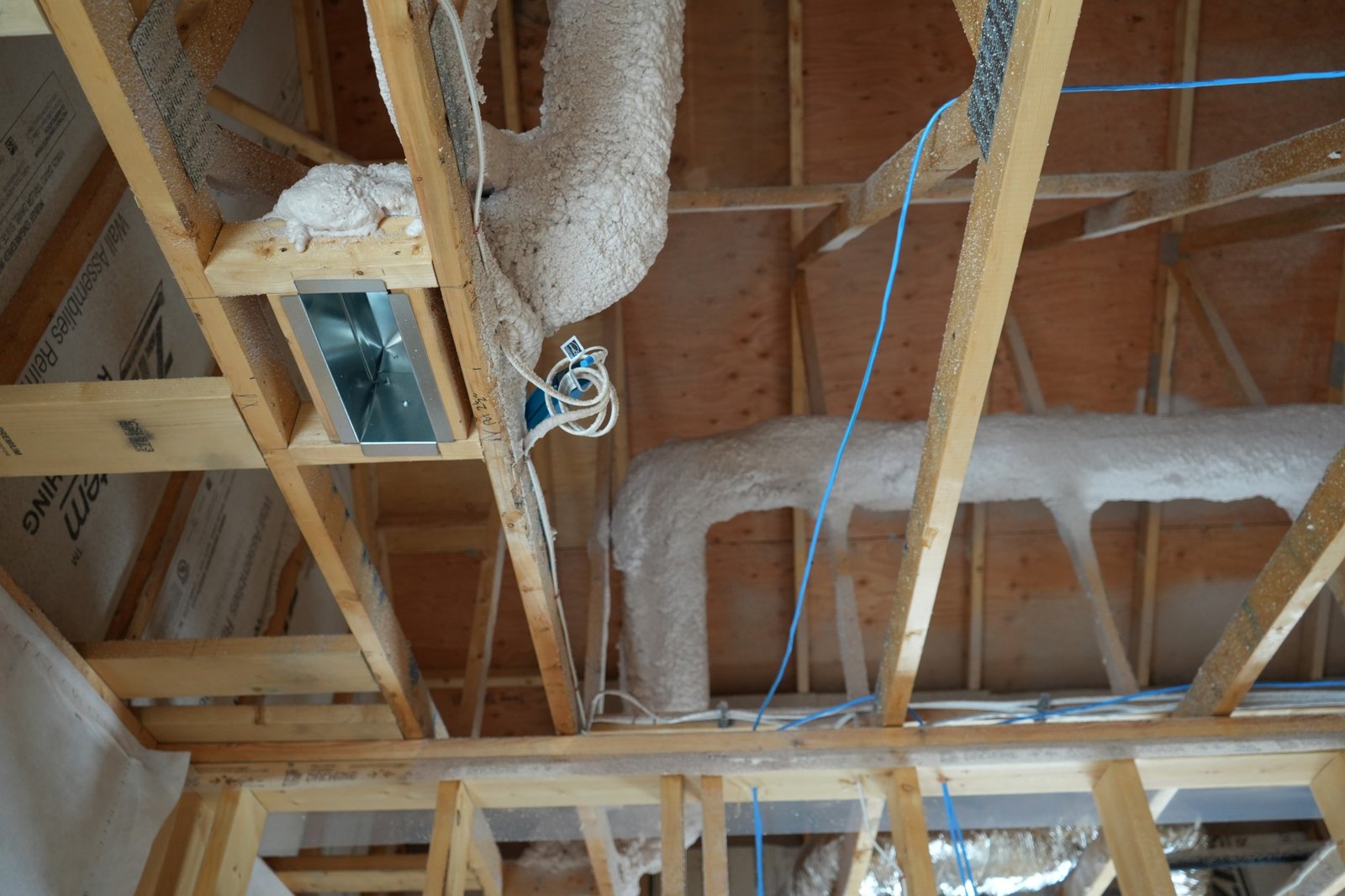
Where mice get into a rural house
Outside Barrie the houses change. In Oro-Medonte and the rest of Simcoe County, a lot of the work is century farmhouses, cottages being converted to four-season use, and properties with a shop, barn or pole building close by. Older rural houses have more ways in than a newer subdivision house, and these are the places to look first:
- The rim joist and sill. The gap between the top of the foundation and the wood framing is one of the largest single air leaks in a Canadian house. In an older farmhouse it is often uninsulated and open to the outside in spots.
- Pipe and wire penetrations. On a rural property that means more holes than a city house has: the well line, the septic, a propane line, an outdoor tap, a dryer vent. Each one is a hole in the foundation or wall, often sealed with whatever was handy on the day.
- Crawl spaces. An open or vented crawl space is a direct route under the floor, and the insulation down there is often damp, fallen or already chewed.
- The roofline. Gaps at the soffit, the fascia and the gable ends let mice into the attic without ever touching the ground floor.
- The attached garage. Door corners and the joint where the garage meets the house.
Spray foam in the rim joist bays and the header spaces closes most of the first item for good. An uninsulated rim joist is also one of the biggest, easiest wins in an older rural house, for heat loss as much as for mice. When you heat with propane, oil, electricity or wood, every dollar of heat that leaks out costs more than it would on natural gas. That is the most common reason rural customers call us.
Spray foam and mice: what to do, in order
- Find how they are getting in. A pest control company can trap and do exclusion work. We identify the entry points we find while we are in the space, especially during removal, and tell you where they are.
- Close the entry points with something a mouse can't chew. Metal or cement at the active holes, before anything else goes in.
- Take out what they have lived in. Contaminated insulation comes out by vacuum, and the space is cleaned.
- Seal, then insulate. Foam where the air leaks are: the rim joist, header spaces, the crawl space, and the bypasses in the attic floor. Then depth on top, to current Ontario Building Code.
One code point is worth knowing before a basement or crawl space job. Foam in an occupied space has to be covered by an approved thermal barrier, usually drywall or an approved coating. We say in the quote what your space needs, so nothing is a surprise at inspection.
Where the cheaper option is fine
You don't need foam everywhere to get a house that mice don't like. On a big open attic floor, the usual answer is to seal the bypasses, then blow in depth. Blown-in gives most of the gain for a lot less than foam on a large area, and with the old contaminated material out, it starts clean.
The same goes for a batt top-up. If what is up there is dry, clean and uncontaminated, new batts on top can be fine. If it is mouse-damaged, adding more just buries the problem. We will tell you which one you are looking at. If a cheaper product will do the same job in your house, we will tell you that too.
Where we fit
We are based in Barrie and work across Simcoe County, Oro-Medonte included, and the Kawartha Lakes area. We do spray foam, blown-in BIBS, batt and insulation removal, so a house with a mouse history gets the removal, the sealing and the re-insulation from one contractor, in the right order.
If you have had a rodent problem, assume the insulation is affected until somebody has actually looked at it. We would rather look at your house than quote you a number from a brochure.
Mice in the attic, or a draft at the rim joist? Call (705) 812-1955 or request a free quote.