

Smart Vapour Barrier
Poly is closed all year. A variable-permeance membrane closes in winter and opens when the wall gets damp. Most walls don’t need the second trick. Some can’t do without it.
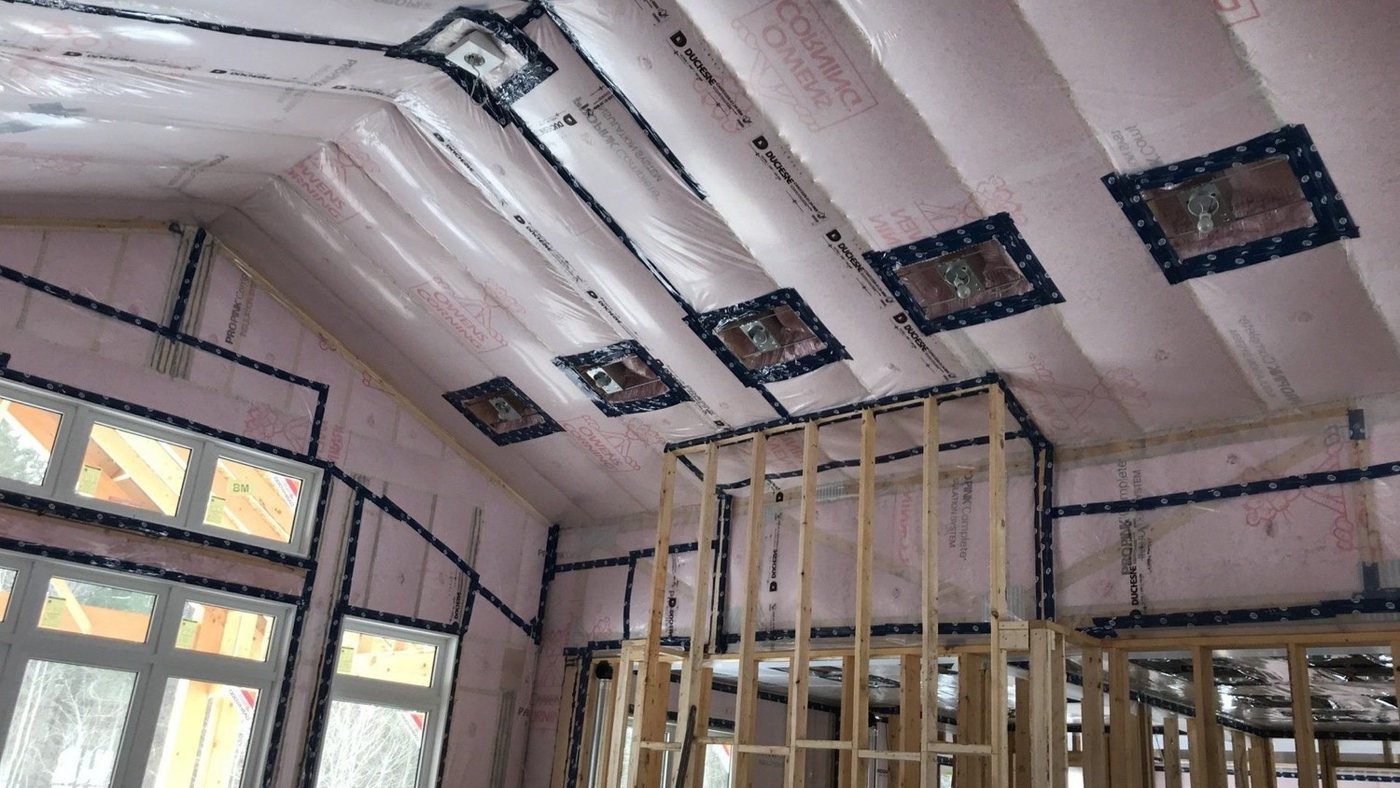
A smart vapour barrier is a film whose permeance changes with humidity: tight when the air around it is dry, open when it gets damp. In a heating climate that means it does poly’s job in January and gets out of the way in July. Whether thatWhether that’s worth several times the price of a roll of 6 mil dependsrsquo;s worth paying more than a roll of 6 mil costs depends entirely on the assembly behind it.
In a plain 2x6 wall with batts, wood sheathing and vented siding, it usually isn’t. In a wall that can’t dry to the outside, it can be the difference between a wall that dries every summer and one that holds whatever got in.
What makes a smart vapour barrier different from poly
Polyethylene’s permeance is close to fixed. It stops vapour diffusion in both directions, all year. That’s what you want on the warm side in winter, when the drive is from the heated room out toward cold sheathing. It’s less useful in summer, when the drive can reverse and the poly stops the wall drying inward too.
A variable-permeance membrane is built to behave differently on each side of that seasonal swing. CertainTeed’s spec language for MemBrain, a 2 mil polyamide (nylon) film, puts it in two numbers: 1 perm or less tested by ASTM E96 dry cup, rising to more than 10 perms by the wet cup method. The film responds to the relative humidity it sits in. When the cavity side is dry, it stays closed. When moisture builds up behind it, it opens and lets the wall dry toward the room.
The same spec sheet sets its limits in plain terms. It’s recommended for heating and mixed climates, not for cooling climates with high outdoor humidity, and the drying benefit drops off under low-permeance interior finishes.
Does it pass as a vapour barrier under the OBC?
A smart vapour barrier can pass, and the reason is the test method. OBC 9.25.4.2.(1), as the City of Markham’s Builder Tip No. 34 quotes it (updated to the 2024 OBC), says vapour barriers shall have a permeance not greater than 60 ng/(Pa·s·m²), “measured in accordance with ASTM E96/E96M … using the desiccant method (dry cup).”
Sixty ng/(Pa·s·m²) is roughly 1 US perm. A membrane rated at 1 perm or less dry cup meets the sentence. Its wet cup number doesn’t enter into it, because the code only asks about dry cup.
Two other sentences from the same tip matter when you choose a product:
- 9.25.4.3.(1) and (2). The vapour barrier protects the warm side of the assembly and, where it’s a different product from the insulation, sits close enough to the warm side to prevent condensation at design conditions. A membrane goes where poly would go.
- 9.25.4.2.(3). Where the use of the space means high moisture generation, the assembly is designed under Part 5. Hold onto that one; it comes back below.
Check sentence numbers against the edition you’re permitting under. The tip’s older 2012-based version numbers some of them differently.
Where it earns its price
The membrane pays for itself where a wall needs to dry inward and poly would stop it. In practice that comes down to three situations.
A low-permeance layer on the outside. Foil-faced or extruded foam board outboard of the sheathing, or a low-perm sheathing, slows drying to the exterior. Poly on the inside closes the other direction. Any moisture that gets into the cavity, from a leak, wet framing at close-in or air leakage, is now between two closed layers. The code’s rules for low-permeance materials on the cold side (Subsection 9.25.5) govern how much of that insulation has to be outboard, and our post on exterior insulation goes through it. A smart vapour barrier on the inside of that wall lets it dry toward the room in the warm months.
Summer vapour drive from the outside. Brick, stone and stucco hold water. When the sun hits a wet face, vapour is driven inward. In an air-conditioned house the inside face of the wall is cool, and poly behind the drywall becomes a cold, closed surface for that vapour to land on. A membrane that opens in damp conditions lets it through to the conditioned side instead.
Interior-side retrofits you can’t change from outside. Opening an older wall from the inside, with cladding and sheathing staying put, you often don’t know what’s out there or how permeable it is. A membrane is the cautious choice when you can’t be sure the wall will dry outward.
Where poly is the right answer
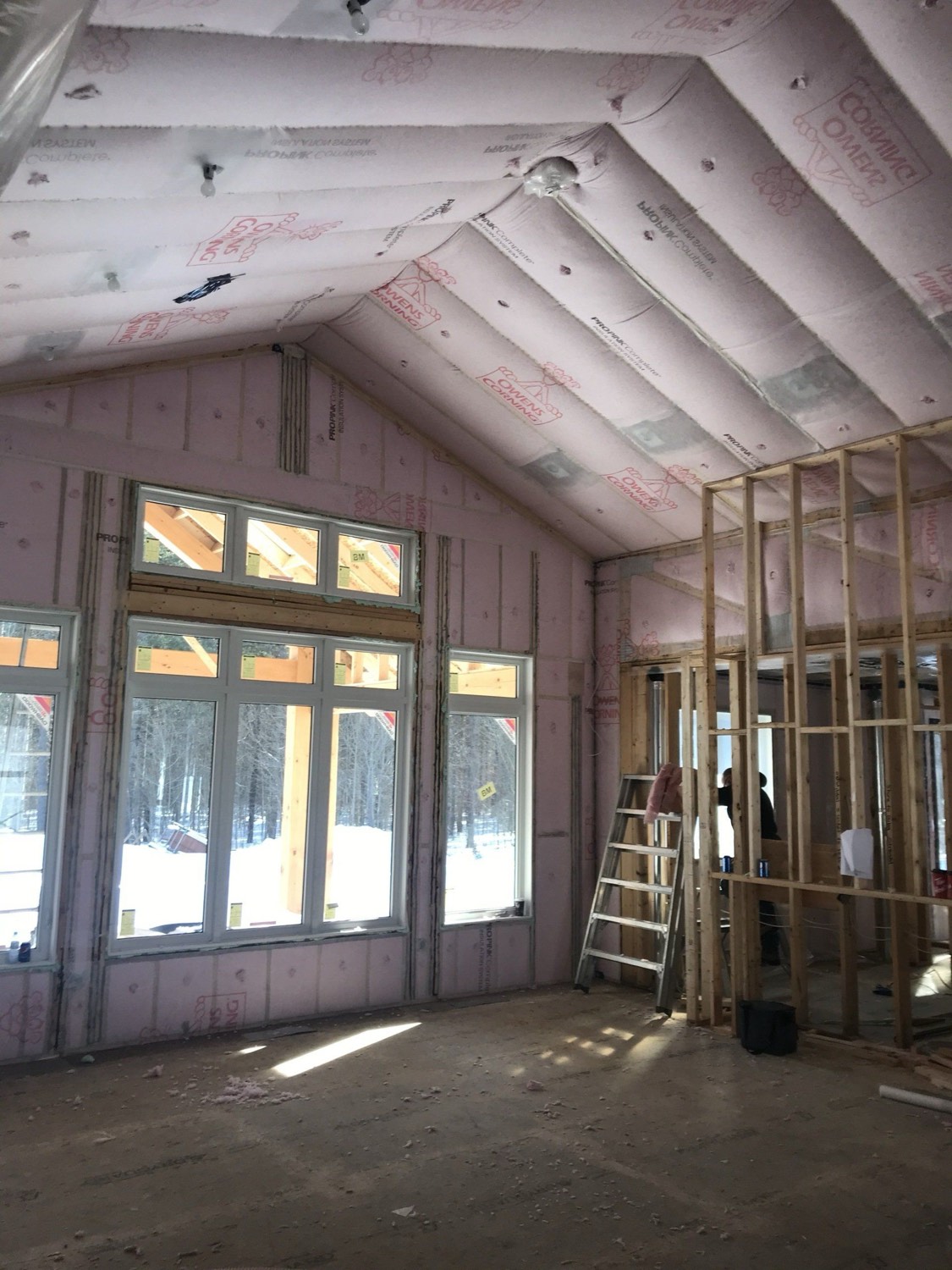
For most wood-frame walls being built right now, 6 mil poly to CAN/CGSB-51.34 is the default because it works. A 2x6 wall with batts, OSB or plywood sheathing, a housewrap and vented vinyl or fibre-cement siding dries outward well. There’s no second closed layer to trap anything. Paying for a membrane there buys a safety margin the wall mostly doesn’t need.
Poly also has the advantage on site. Inspectors know what it is, crews know how to lap and seal it, and nobody needs a spec sheet to prove it passes. If the money’s tight, the better spend is usually on getting the poly’s details right at the top plates, the rim and every box than on swapping the film.
And where the wall is getting closed-cell foam, you don’t need either. Builder Tip 34 says the separate vapour barrier can be eliminated where 50 mm of 2 lb closed-cell spray foam provides the 60 ng/(Pa·s·m²) maximum. A membrane over that foam is paying twice for a vapour barrier, and the foam is low-perm, so there’s nothing behind the membrane for it to help dry.
It is still the air barrier, and still has to be continuous
A smart vapour barrier controls diffusion. It does nothing about air leakage, and air leakage moves far more moisture into a cold cavity than diffusion does. If the membrane is also the interior air barrier, every detail that applies to poly applies to it:
- Laps sealed with the tape the manufacturer lists for that film. Not whatever’s in the truck.
- Sealed at top plates, rim and the floor line, and at window and door rough openings.
- Every electrical box in a pan or an airtight box, with the membrane sealed to the flange. The detail is the same as with poly; see vapour barrier electrical box.
- Tears and staple holes taped before drywall.
If you’re relying on it as the air barrier and not just the vapour barrier, make sure the product is sold and documented for that. CertainTeed, for one, markets a version as a continuous air barrier and smart vapor retarder. A membrane with gaps at the plates is a very expensive way to build a leaky wall.
What has to be ready before the crew arrives
- The product named on the drawings. If the permit set says polyethylene and the wall gets a smart vapour barrier, expect a question at inspection.
- The data sheet on site. The inspector will want to see the dry-cup permeance at or under 60 ng/(Pa·s·m²). Have it in the site binder, not on somebody’s phone in another town.
- Tape and sealant from the same system. Ordered with the membrane, and confirmed before the day, not after.
- Services roughed in and inspected. Boxes in pans, penetrations final. Same sequencing as poly.
- Interior finishes decided. If the room is getting vinyl wallcovering or another low-perm finish, the membrane’s drying benefit is mostly gone. Know that before you buy it.
Where a smart vapour barrier is the wrong product
The membrane opens when the humidity around it rises. That’s the point in summer and the problem in a room that’s humid all winter. An indoor pool, a hot tub room or anything else with high moisture generation falls under 9.25.4.2.(3) and a Part 5 design, and a film that opens at high humidity is the wrong default there. Leave that one to the designer.
It’s also the wrong product behind a low-perm interior finish, over closed-cell foam, and in a wall that dries outward without help. That covers a large share of new walls. Using a smart vapour barrier everywhere because it’s the newer product is the same mistake as spray-foaming every cavity because it’s the better insulation.
Where we fit
On new work, the vapour barrier is part of how we install batt insulation: it’s detailed and sealed as required, and the job is left ready for the building inspector and the drywall crew. Poly that is torn, unsealed at the seams or missing at the top plates is a leak path for warm, humid air, which is how condensation problems start inside a wall. Where an assembly needs an air and vapour barrier in one, closed-cell spray foam is insulation, air barrier and vapour retarder in one step, applied by certified applicators under CAN/ULC-S705.2.
The envelope decisions that matter most are cheapest to get right before the drywall goes on, so bring us in at the drawings. If a cheaper product will do the same job in your build, we’ll tell you. For the rules behind all of this, see Ontario Building Code insulation.
Got a build at the drawing stage and not sure whether the walls need poly, a membrane or foam? Call (705) 812-1955 or request a free quote.